Política de estoque não é sobre ter mais ou menos. É sobre ter o estoque certo, no segmento certo, com a meta certa.
O erro mais caro na gestão de estoque é tratar todos os produtos da mesma forma. Adotar uma política única de estoque e nível de serviço (por exemplo, 30 dias de estoque ou um nível plano de 95%) infla capital de giro onde não importa e deixa desprotegido onde importa. A segmentação ABC-XYZ é o antídoto: força a política a refletir a realidade operacional e financeira de cada produto. A política precisa ser calibrada para o contexto de cada negócio e revisada periodicamente, não existe fórmula universal.
Por que Diferenciar a Política de Estoque
O inventário atua como o amortecedor estratégico entre a variabilidade da oferta e a demanda. A questão central não é "quanto estoque manter", mas sim "qual nível de serviço cada item ou segmento realmente exige, dado o seu impacto financeiro e operacional".
Quando todos os produtos recebem a mesma meta de nível de serviço, itens de baixo valor e demanda imprevisível acumulam estoque desnecessário, enquanto itens estratégicos e de alta margem podem ficar subprotegidos. O resultado é um inventário inchado que não atende bem onde mais importa.
Uma política de estoque bem desenhada considera que cada segmento de produto tem características próprias de demanda, margem, fornecimento e importância estratégica. A diferenciação é o que transforma estoque de custo em ativo estratégico.
Direcionadores do Nível de Serviço
O objetivo é utilizar esses direcionadores para definir metas que otimizem o trade-off entre disponibilidade e custo.
Margem e Lucratividade
Itens de maior margem justificam níveis de serviço mais altos, pois o custo de uma ruptura é proporcionalmente maior em perda de lucro.
Previsibilidade da Demanda
Itens com demanda estável e previsível (classificação X) exigem menos estoque de segurança do que itens erráticos (Z), mesmo com volume similar.
Custo de Manutenção
Capital imobilizado, armazenagem, obsolescência e deterioração. Quanto maior o custo de manter, mais precisa deve ser a meta de estoque.
Custo da Ruptura
Vendas perdidas, insatisfação do cliente, penalidades contratuais. Segmentos com alto custo de ruptura exigem proteção reforçada.
Importância Estratégica
Produtos emblemáticos, obrigações contratuais ou itens que definem posicionamento competitivo merecem tratamento diferenciado.
Características do Fornecimento
Confiabilidade do lead time, risco do fornecedor, flexibilidade de lote. Fornecimento instável demanda mais buffer de proteção.
Acuracidade da Previsão
A acuracidade da previsão determina diretamente o tamanho do buffer. SKUs bem previstos merecem estoque de segurança menor; SKUs com erro alto precisam de mais proteção, ou de previsão melhor.
O objetivo é utilizar esses direcionadores para definir metas que otimizem o trade-off entre disponibilidade e custo. Não existe uma fórmula universal: a calibração depende do contexto de cada negócio e deve ser revisada periodicamente.
Matriz ABC-XYZ Interativa
A classificação ABC-XYZ combina dois eixos: volume/valor (ABC) e previsibilidade da demanda (XYZ). O resultado é uma matriz 3x3 que permite visualizar 9 segmentos com perfis distintos de comportamento, cada um exigindo estratégia, nível de serviço e frequência de ressuprimento específicos.
Clique nos cards abaixo para alternar entre as visões e explorar os detalhes de cada segmento. Clique em qualquer produto para ver a ficha completa.
Como Classificar XYZ
O eixo XYZ mede a previsibilidade da demanda. A abordagem mais comum usa o coeficiente de variação (CoV) da demanda:
- •X — Estável: CoV < 0,5. Demanda previsível, baixa dispersão em torno da média.
- •Y — Flutuante: CoV entre 0,5 e 1,0. Demanda tem oscilações perceptíveis mas padrões identificáveis (sazonalidade, tendência).
- •Z — Errática: CoV > 1,0. Demanda é irregular, difícil de prever apenas com histórico.
Os limiares variam por setor, ajuste conforme a distribuição do seu portfólio.
O critério pode, e às vezes deve, ser diferente. CoV funciona bem quando a maioria dos SKUs é pedida regularmente. Mas em portfólios com muitos slow-movers, demanda intermitente ou ciclos de pedido longos, o CoV se torna enganoso: um SKU pedido uma vez por trimestre pode mostrar CoV baixo simplesmente porque a maioria das semanas é zero. Nesses casos, frequência de pedido (com que frequência o SKU é requisitado por período) é um sinal melhor de previsibilidade do que dispersão estatística. Outros critérios válidos incluem erro de previsão (RMSE ou MAPE por SKU), índices de intermitência de demanda (por exemplo, ADI/CV² para classificação no estilo Croston), ou regras definidas pelo negócio atreladas ao ciclo de vida do produto.
O princípio se mantém: XYZ deve separar o que você consegue planejar do que você não consegue. Escolha o critério que reflete essa distinção no seu contexto.
Alto Volume
Volume Médio
Baixo Volume
A tabela abaixo resume as ações recomendadas para cada segmento da matriz ABC-XYZ, incluindo o processo de ressuprimento, a estratégia de estoque de segurança e o tipo de controle de inventário mais adequado.
| Volume de Consumo | Previsibilidade de Demanda | Classe | Processo de Ressuprimento | Estoque de Segurança | Controle de Inventário |
|---|---|---|---|---|---|
| ALTO Volume | Demanda ESTÁVEL | AX | Ressuprimento automatizado | BAIXO buffer – JIT ou consignação transfere a responsabilidade pela segurança do fornecimento | Inventário perpétuo |
| ALTO Volume | Demanda VOLÁTIL | AY | Automatizado com intervenção manual | BAIXO buffer – aceitar risco de ruptura | Inventário perpétuo |
| ALTO Volume | Demanda MUITO VOLÁTIL | AZ | Automatizado com intervenção manual | Ajustar buffer manualmente para sazonalidade | Inventário perpétuo |
| MÉDIO Volume | Demanda ESTÁVEL | BX | Ressuprimento automatizado | BAIXO buffer – segurança primeiro | Contagem periódica; segurança MÉDIA |
| MÉDIO Volume | Demanda VOLÁTIL | BY | Automatizado com intervenção manual | Ajustar buffer manualmente para sazonalidade | Contagem periódica; segurança MÉDIA |
| MÉDIO Volume | Demanda MUITO VOLÁTIL | BZ | Automatizado com intervenção manual | ALTO buffer – segurança primeiro | Contagem periódica; segurança MÉDIA |
| BAIXO Volume | Demanda ESTÁVEL | CX | Ressuprimento automatizado | BAIXO buffer – segurança primeiro | Estoque livre ou estimativa periódica por inspeção ou pesagem; segurança BAIXA |
| BAIXO Volume | Demanda VOLÁTIL | CY | Ressuprimento automatizado | ALTO buffer – segurança primeiro | Estoque livre ou estimativa periódica por inspeção ou pesagem; segurança BAIXA |
| BAIXO Volume | Demanda MUITO VOLÁTIL | CZ | Ressuprimento automatizado | ALTO buffer – segurança primeiro | Estoque livre ou estimativa periódica por inspeção ou pesagem; segurança BAIXA |
Cálculo do Estoque de Segurança
O estoque de segurança existe para proteger contra incertezas. As duas principais fontes de incerteza são a variabilidade da demanda e a variabilidade do leadtime. Use os controles abaixo para visualizar como cada uma afeta o risco de ruptura.
Quando a demanda é previsível, o estoque cai de forma linear e o ressuprimento chega no momento certo. Conforme a incerteza aumenta, o ponto futuro de consumo se torna um leque de possibilidades, aumentando o risco de ruptura.
APICS (atual ASCM) é a principal associação global de profissionais de supply chain — seu corpo de conhecimento define as quatro fórmulas padrão de estoque de segurança abaixo. Adicionamos duas fórmulas extras como extensões usadas em processos S&OP maduros: uma baseada na acuracidade da previsão e outra que também incorpora o OTIF do fornecedor.
Calculadora APICS Padrão de Estoque de Segurança
Selecione uma das 4 fórmulas APICS para ver em detalhe, ou compare lado a lado.
1 – Demanda
Protege contra a variabilidade da demanda, assumindo leadtime constante.
SS = Z × σ(D) × √L2 – Leadtime
Protege contra a variabilidade do leadtime, assumindo demanda constante.
SS = Z × D × σ(L)3 – Dependentes
Variáveis correlacionadas: a incerteza combinada é menor que a soma individual.
SS = Z × √(σ(D)² × L + D² × σ(L)²)4 – Independentes
Variáveis independentes: a proteção é a soma dos dois componentes separados.
SS = Z × σ(D) × √L + Z × D × σ(L)Por Que Variabilidade ≠ Incerteza
Um exemplo real: um produto com demanda estável e um pico de Black Friday.
Ago— | Set— | Out— | NovBlack Friday | |
|---|---|---|---|---|
| Demanda real | 9 | 11 | 10 | 58 |
| Previsão | 10 | 10 | 10 | 55 |
| Erro absoluto | 1 | 1 | 0 | 3 |
A variabilidade bruta da demanda inflaria o estoque de segurança de um produto cuja previsão captura corretamente o pico sazonal.
Quando a sazonalidade é capturada na previsão, o erro de previsão reflete a incerteza real que o estoque de segurança precisa cobrir.
Mesmo produto. Mesmos dados. Duas métricas que levam a decisões drasticamente diferentes de estoque de segurança. As fórmulas a seguir substituem variabilidade por incerteza.
Calculadora Avançada: Acuracidade da Previsão e OTIF do Fornecedor
AvançadoPara processos S&OP maduros que medem a acuracidade da previsão e o OTIF do fornecedor. Selecione uma fórmula ou compare ambas.
Inclua o período de revisão no leadtime. Veja Erros Comuns para entender por quê.
OTIF (no prazo E completo). Medir só pontualidade ou só completude subestima a exposição real.
5 – Orientada por Previsão (Processo Maduro)
Usa a acuracidade da previsão em vez da variabilidade da demanda quando seu processo de S&OP for maduro.
SS = Z × (1 − Accuracy) × D × √LO estoque de segurança protege contra o que você não consegue prever, não contra as variações conhecidas da demanda — distinção especialmente importante quando há oscilações previsíveis como sazonalidade ou promoções. A acuracidade da previsão captura o que de fato precisa ser amortecido: o erro entre o que você previu e o que aconteceu. Substituir σ por (1 − Acuracidade) × D faz o estoque de segurança escalar com a qualidade da previsão, não com o volume bruto de oscilação. O indicador de acuracidade mais adequado (1 − MAPE, 1 − WAPE etc.) depende do perfil do erro de previsão e não é abordado neste artigo.
6 – Acuracidade da Previsão + OTIF do Fornecedor
Adiciona a confiabilidade do fornecedor à fórmula anterior.
SS = Z × √[ ((1 − Accuracy) × D)² × L + ((1 − OTIF) × D × L)² ]A fórmula anterior captura a incerteza da previsão. Mas a qualidade da previsão não é a única fonte de risco: fornecedores também falham. Atrasos, entregas parciais e erros criam incerteza de suprimento, independente da qualidade da previsão. Esta fórmula combina ambas as incertezas usando a mesma lógica de variáveis independentes da fórmula APICS 3. Quando o OTIF está consistentemente acima de 95%, a incerteza de suprimento é pequena e esta fórmula converge para a fórmula 5. Quando o OTIF cai abaixo de 90%, a confiabilidade do fornecedor frequentemente se torna a fonte dominante de risco — e ignorá-la produz buffers perigosamente finos. Ressalva: se o OTIF de um fornecedor está consistentemente abaixo de 75%, a resposta não é mais estoque de segurança — é outro fornecedor.
Uma Nota sobre a Premissa de Normalidade
Todas as seis fórmulas das duas calculadoras acima assumem que demanda ou erro de previsão seguem distribuição normal — premissa que raramente se sustenta em SKUs reais. Na prática, o fator Z da tabela normal vai super ou subestimar o buffer necessário, especialmente nas caudas da distribuição.
Para SKUs onde o custo do erro é alto (itens A, SKUs críticos), pode ser útil validar a política com simulação histórica em vez de confiar apenas na fórmula que presume distribuição normal.
Demanda Dependente: Quando o Buffer Olha para o Consumo, Não para a Demanda
Todas as fórmulas acima assumem demanda independente: a demanda do SKU vem direto do cliente final e é estimada via previsão. Funciona bem para produtos acabados.
Para matérias-primas e componentes, a demanda é dependente: vem da explosão da BOM dos produtos acabados que aquela matéria-prima compõe. Uma matéria-prima que entra em 10 produtos diferentes não tem "previsão" no sentido tradicional, ela tem um consumo derivado do plano de produção desses 10 produtos.
Nesses casos, o estoque de segurança deve ser dimensionado contra a incerteza do consumo, não contra a previsão de vendas. As fontes de incerteza também mudam: variações no plano de produção, perdas de processo (rendimento), múltiplos de lote da formulação. A fórmula clássica continua aplicável, mas σ e RMSE precisam ser medidos sobre a série de consumo da matéria-prima, não sobre a demanda dos produtos finais.
Outro ponto importante para matérias-primas: a agregação de demanda entre produtos finais costuma reduzir a variabilidade relativa. Uma matéria-prima que abastece 10 SKUs com sazonalidades diferentes terá um perfil de consumo mais estável que cada SKU individualmente. Isso geralmente justifica buffers proporcionalmente menores em matérias-primas que em produtos acabados, mesmo quando o lead time do fornecedor é maior.
Quando a Fórmula Não Basta
As fórmulas acima são úteis como ponto de partida e como forma de comunicar a lógica de estoque pelo negócio. Mas têm limites estruturais:
- •Assumem distribuições estatísticas específicas que raramente correspondem à demanda real.
- •Otimizam contra uma única métrica de nível de serviço, que muitas vezes não está alinhada com o que o negócio mede (OTIF).
- •Tratam cada SKU de forma isolada, ignorando recursos compartilhados e calendários produtivos.
- •Produzem um número estático, o mesmo buffer independentemente de onde você está no ciclo de demanda.
Para SKUs onde essas limitações pesam mais (itens de alto valor, supply complexo, sazonalidade forte), a simulação histórica é a abordagem mais robusta: roda sua política contra a demanda passada e observa o trade-off real entre estoque e serviço. É computacionalmente mais pesada, mas não exige nenhuma premissa distribucional.
O Trade-off Financeiro do Estoque de Segurança
Toda fórmula apresentada acima otimiza precisão técnica: dimensionar o buffer que cobre a incerteza com determinado nível de serviço. Mas estoque de segurança não é só um número técnico, é capital imobilizado. A política certa não é só a que atinge o nível de serviço alvo, é a que atinge o nível de serviço alvo ao menor custo total.
O custo total combina três componentes que raramente entram nas fórmulas:
- •Custo de carregamento (carrying cost): capital parado, armazenagem, obsolescência, deterioração, seguros. Tipicamente entre 15% e 35% do valor do estoque ao ano, dependendo do setor.
- •Custo de ruptura (stockout cost): vendas perdidas, penalidades contratuais, custo de expedição emergencial, impacto na confiança do cliente. Difícil de medir mas frequentemente o maior dos três.
- •Custo de capital: o retorno que esse capital geraria se aplicado em outro lugar do negócio (CAPEX, expansão, R&D). Para empresas com restrição de capital de giro, esse é o custo dominante.
Para um decisor financeiro, a pergunta relevante raramente é "qual fórmula de estoque de segurança usar". É "qual nível de serviço vale o investimento que ele exige por segmento". A resposta varia drasticamente: itens estratégicos com alta margem podem justificar 99% de nível de serviço mesmo com custo alto, enquanto itens de baixo giro e baixa margem podem operar com 80% ou menos sem impacto material no negócio.
A fórmula entra depois dessa decisão, não antes. Calcular o buffer ideal sem antes definir o nível de serviço economicamente justificável é otimizar precisão sobre a pergunta errada.
Na prática: revisões de política de estoque que incluem o componente financeiro frequentemente identificam segmentos onde o capital imobilizado em buffer excede o custo esperado de ruptura. Reduzir o nível de serviço alvo nesses segmentos libera capital sem aumentar o risco efetivo do negócio.
Simulador de Custos
- Custo de Estoque
- Custo de Ruptura
- Custo Total
Para os parâmetros atuais, o ponto ótimo é 7 dias de cobertura, equivalente a 78.2% de nível de serviço. Custo total mínimo estimado: R$ 5.2k/ano.
Reduzir esse alvo em 5 dias liberaria R$ 1.9k em capital, ao custo adicional de R$ 2.3k em ruptura — trade-off equilibrado, depende do contexto estratégico.
Meta em Dias vs. Unidades: Por que Metas Estáticas Falham
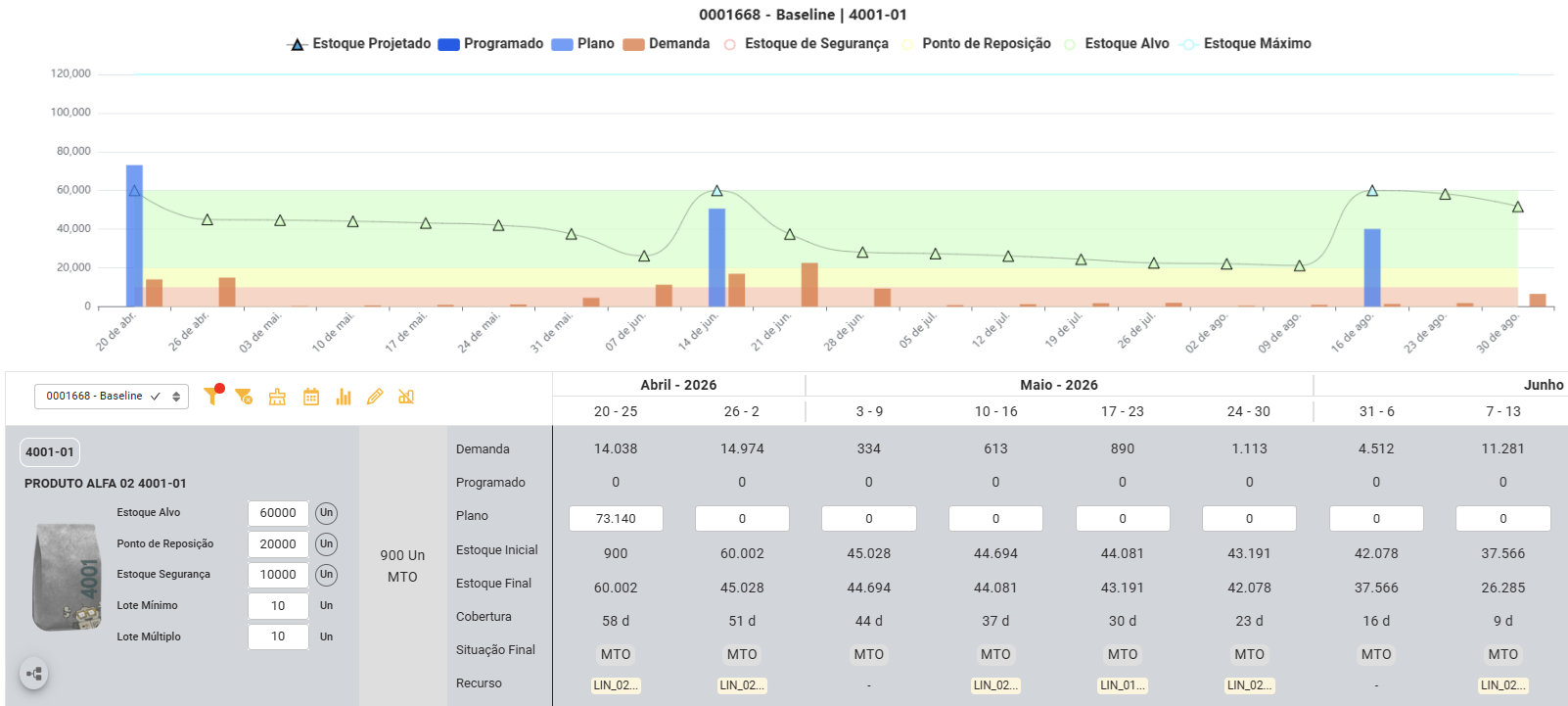
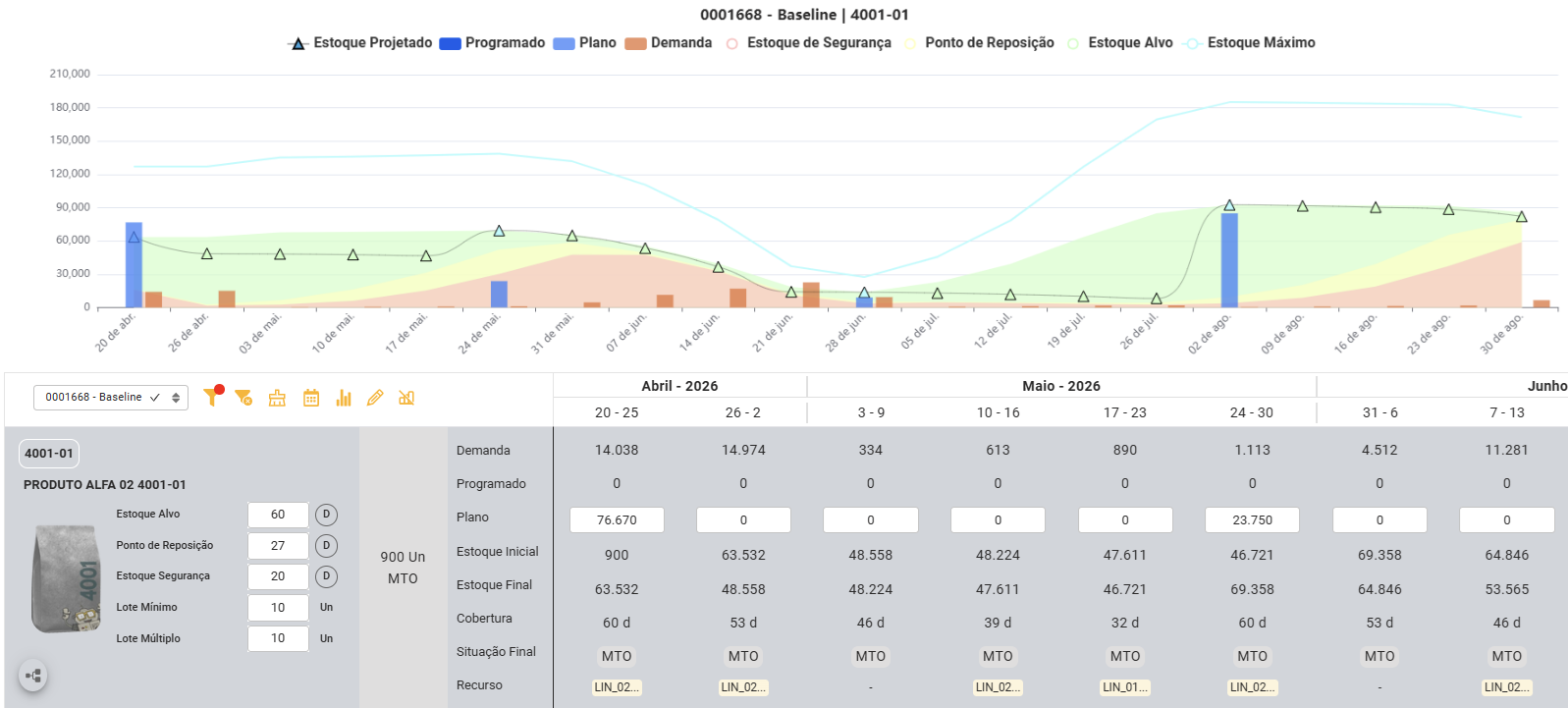
Depois de calcular seu estoque de segurança, a próxima decisão é como expressar a meta de estoque. A maioria dos planejadores adota unidades por padrão, manter 60.000 unidades do SKU X. Isso funciona em contextos estáveis, mas falha no momento em que a demanda muda de forma: sazonalidade, crescimento, promoções, ciclo de vida. A alternativa é expressar a meta em dias de cobertura, que escala automaticamente com a demanda futura.
Por que isso importa
- •Uma meta em unidades te dá o mesmo buffer independentemente de onde você está no ciclo de demanda, exatamente quando você precisa de proteção diferente.
- •Uma meta em dias traduz a intenção do negócio (quero X semanas de segurança) em uma política que se adapta conforme a previsão evolui.
- •A comunicação entre áreas melhora: Estamos com 32 dias de cobertura é universalmente entendido entre funções. Estamos com 47.611 unidades não é.
Dias de cobertura deve ser o padrão para qualquer SKU com demanda não plana. Reserve metas em unidades para itens verdadeiramente estáveis e de baixo volume onde a conversão não agrega valor.
Erros Típicos na Gestão de Estoque
Mesmo empresas com boas intenções cometem erros recorrentes na gestão de estoque. Reconhecer esses padrões é o primeiro passo para corrigi-los.
Classificar ABC apenas por volume
Nunca faça ABC apenas por volume e nunca misture unidades de medida. Um item "A" por volume pode ter margem baixíssima, enquanto um item "B" por volume pode ser o mais lucrativo do portfólio. A classificação deve considerar valor financeiro e impacto no resultado.
Esquecer o Período de Revisão no Lead Time
Um erro comum é dimensionar o estoque de segurança apenas contra o lead time, ignorando com que frequência você de fato revisa a política de ressuprimento. Se o lead time é de 5 dias mas você revisa o pedido a cada 7 dias, sua janela real de exposição é de 12 dias, não 5. O período de revisão funciona como uma extensão do lead time: amplia a janela em que você não tem chance de reagir. Em toda fórmula de estoque de segurança, o lead time deve ser substituído por lead time + período de revisão. Políticas de revisão contínua são extremamente raras na prática.
Confundir Variabilidade com Erro de Previsão
Incerteza não é o desvio padrão da demanda — é a dificuldade de acertar a previsão. Muitos planejadores usam o desvio padrão da demanda histórica (σ) como se fosse a mesma coisa que erro de previsão. Não são. Variabilidade da demanda mede como a demanda oscila em torno da média. Erro de previsão mede o quanto sua previsão errou. Uma demanda sazonal pode ter alto desvio, mas se o padrão é conhecido, ela é previsível — o que importa é a capacidade de antecipar o comportamento. Um produto altamente sazonal pode ter variabilidade enorme mas erro de previsão pequeno, se a sazonalidade for bem capturada. Dimensionar estoque de segurança pela métrica errada leva a excesso e ruptura, geralmente ambos, em SKUs diferentes.
Meta única de nível de serviço
Definir 95% ou 99% para tudo parece simples, mas é ineficiente. Produtos de alto giro e margem merecem proteção máxima. Itens imprevisíveis e de baixo volume operam melhor com metas menores, evitando acúmulo desnecessário de estoque.
Subestimar os itens C
CX tem baixo impacto e demanda estável, aceitando nível de serviço menor com pouco estoque de segurança. Já CZ é altamente volátil e, apesar de parecer precisar de mais proteção, costuma ser a maior fonte de sleeping stock. Na prática, definir metas mais baixas para CZ evita acúmulo desnecessário.
Tratar Lead Time como Fixo e Confiável
A maioria dos cálculos de estoque de segurança assume que lead times são estáveis e previsíveis. Na realidade, lead times de fornecedor variam, às vezes dramaticamente. Pior: a variabilidade histórica do lead time costuma ser um péssimo preditor da variabilidade futura, porque as causas subjacentes (capacidade do fornecedor, disrupções logísticas, eventos geopolíticos) mudam com o tempo. A incerteza do lead time merece tratamento explícito na política, não uma média estática puxada do ERP.
Definir a Política e Esquecê-la
Política de estoque não é projeto, é processo. Padrões de demanda mudam, fornecedores mudam, produtos amadurecem ou declinam, a estratégia do negócio evolui. Uma política calibrada 18 meses atrás está quase certamente descalibrada hoje. Times best-in-class revisam a classificação ABC-XYZ e as metas de nível de serviço trimestralmente, não anualmente.
Como Resolvemos com NPLAN
O NPLAN resolve cada um desses desafios de forma integrada e automatizada, eliminando a complexidade operacional de manter uma política de estoque diferenciada.
Segmentação Automática e Sempre Atualizada
A classificação ABC-XYZ é recalculada automaticamente conforme os dados de demanda e consumo evoluem. Isso elimina o risco de classificações obsoletas, um dos maiores problemas de quem faz segmentação manual em planilhas.
Estratégias por Classificação de Criticidade
As estratégias podem ser segregadas em diferentes classificações de criticidade, com políticas distintas para produto acabado, intermediário e matéria-prima. Além disso, é possível definir exceções por SKU específico quando necessário.
Ressuprimento, Nível de Serviço e Ciclo por Segmento
Para cada classificação, o NPLAN permite configurar a estratégia de ressuprimento adequada, o nível de serviço alvo e o ciclo de reposição ideal, tudo de forma diferenciada e alinhada aos direcionadores do negócio.
Integração com Qualidade da Previsão
O NPLAN conecta o cálculo de estoque de segurança diretamente à acurácia da previsão por SKU. Conforme seu processo de previsão amadurece, os buffers se reduzem automaticamente, convertendo melhorias de qualidade da previsão em capital liberado do estoque, com ROI mensurável.
Integração Financeira
O impacto de cada política é traduzido em capital imobilizado, permitindo que decisões de estoque sejam avaliadas também pela ótica financeira, e não apenas operacional.
Projeção de Ocupação Física
O estoque projetado pela política é convertido em ocupação de espaço físico de armazenagem, antecipando gargalos de capacidade antes que eles aconteçam.
Conversão em Dias de Estoque
Todas as projeções são apresentadas também em dias de estoque, facilitando a comunicação entre áreas e a comparação entre diferentes categorias de produto.
Análise de Saúde dos Estoques
A política definida é comparada automaticamente com a situação atual dos estoques, gerando uma análise de saúde que identifica excessos, rupturas e desvios. Tema que aprofundaremos em um próximo artigo.
Simulação de Cenários
Tudo pode e deve ser simulado com diferentes estratégias através da comparação de cenários. O NPLAN permite avaliar o impacto de mudanças na política antes de implementá-las, reduzindo risco e acelerando decisões.
A imagem abaixo ilustra como o NPLAN apresenta a política de estoque de forma consolidada: cada SKU é classificado automaticamente na matriz ABC-XYZ, com a estratégia de ressuprimento, nível de serviço, ciclo e estoque de segurança calculados e exibidos em uma única visão integrada, incluindo os impactos em capital imobilizado e ocupação de armazenagem.
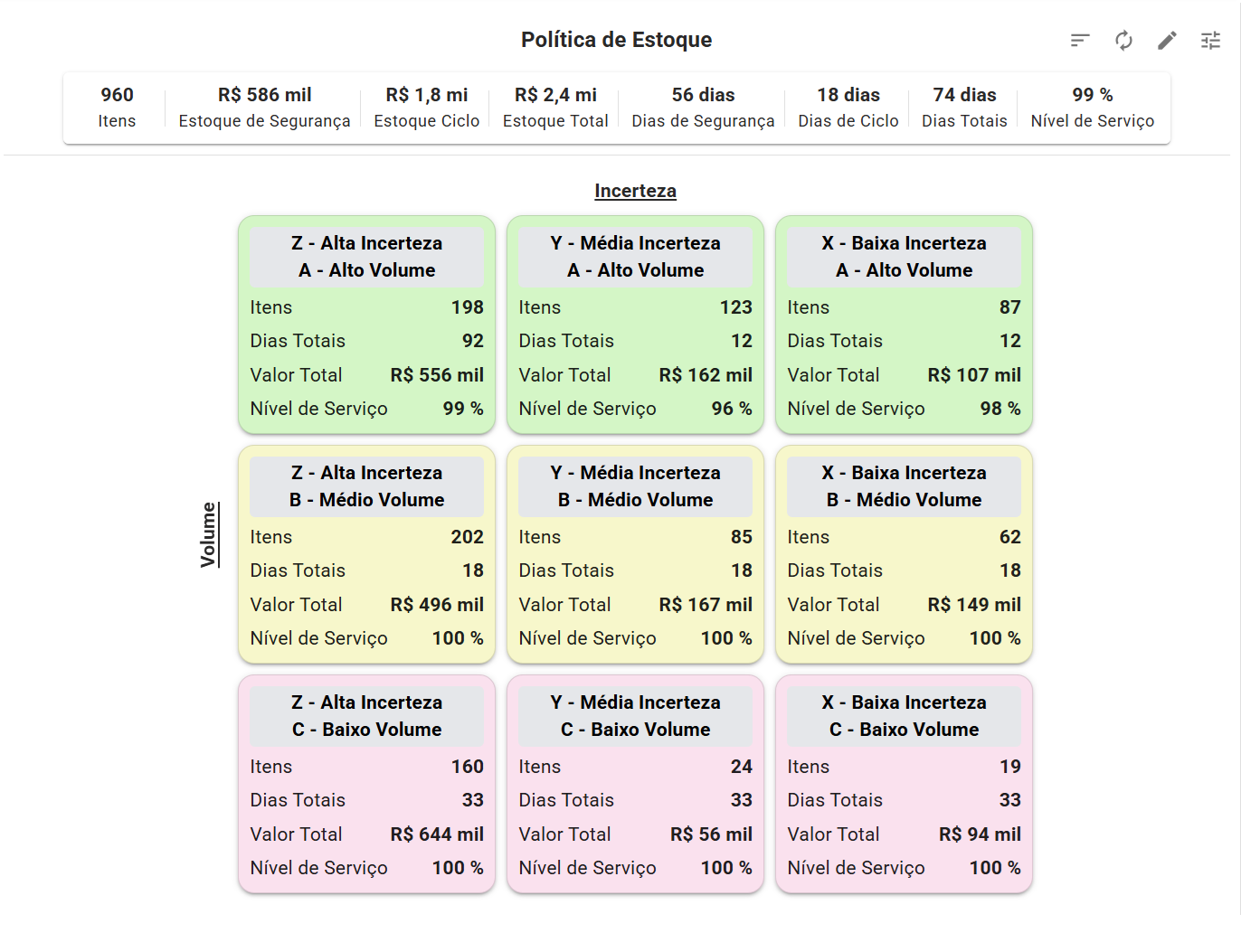
Com o NPLAN, a política de estoque deixa de ser um exercício estático em planilhas e se torna um processo vivo, integrado e estratégico, sempre alinhado com a realidade do negócio.
10 Dicas e Truques para Reduzir Estoque Hoje
Além de calibrar a política, aqui estão 10 alavancas que você pode acionar neste trimestre para liberar capital de giro. Cada item tem um perfil diferente de esforço/impacto, comece pelos Quick Wins.
Eliminar Estoque Obsoleto
Mapear itens sem giro por períodos prolongados e definir plano de ação imediato.
Sinalizar Slow Movers
Itens com giro muito baixo que estão consumindo espaço e capital desnecessariamente.
Cancelar Pedidos em Aberto
Revisar ordens de compra pendentes para itens com excesso ou demanda revisada para baixo.
Negociar Devoluções a Fornecedores
Negociar retorno de materiais ainda dentro de prazo e condições contratuais.
Rodar Promoções Direcionadas
Utilizar campanhas para acelerar o giro de itens com excesso, especialmente CY e CZ.
Pausar Novos Lançamentos
Reavaliar lançamentos previstos quando o portfólio já apresenta excesso na mesma categoria.
Doar ou Descartar
Último recurso para itens irrecuperáveis. Libera espaço e reduz custo de manutenção.
Recalibrar Parâmetros de Ressuprimento
Ajustar lotes mínimos, lead times e pontos de reposição com base em dados reais de consumo e fornecimento.
Alinhar Política com Estratégia Comercial
Garantir que as metas de nível de serviço reflitam as prioridades do negócio, não apenas padrões genéricos.
Monitorar Continuamente com Indicadores em Tempo Real
Monitoramento contínuo com indicadores de cobertura, giro e aging para agir antes que o problema cresça.
A combinação de política diferenciada com gestão ativa do inventário existente é o que separa empresas com estoque bem dimensionado de empresas que apenas "empurram" excesso para o próximo ciclo. O NPLAN permite configurar essas políticas por segmento e acompanhar a aderência com indicadores de cobertura, giro e aging em tempo real.
Política é um Desejo — A Realidade Tem Restrições
Tudo que discutimos até aqui — segmentação ABC-XYZ, fórmulas de estoque de segurança, dias de cobertura, níveis de serviço diferenciados — produz aquilo que o negócio deseja manter em estoque. É a política ideal: matematicamente sólida, segmentada por criticidade, calibrada pela qualidade da previsão. Mas a política calculada ainda não é um plano executável. Entre o desejo e a realidade existe uma camada de restrições que pode tornar até a política mais bem desenhada impossível de seguir tal como está.
As Restrições que Reformatam Sua Política
Quatro famílias de restrições normalmente forçam a política calculada a se dobrar:
Armazenagem Física
Você pode calcular que o SKU X precisa de 60 dias de cobertura, mas se o armazém não comporta fisicamente esse volume, a política é ficção. Capacidade de armazenagem — pallets, prateleiras, área refrigerada, área para inflamáveis — é um teto rígido. A política de estoque precisa ser validada contra a ocupação física, não apenas contra a lógica financeira.
Capital de Giro
A política ideal pode exigir R$ 75M em estoque. O negócio pode ter apenas R$ 45M disponíveis. Restrições de capital não desaparecem porque a fórmula diz o contrário — elas forçam priorização: quais segmentos recebem o buffer integral, quais recebem parcial, quais operam enxutos e aceitam maior risco de ruptura.
Lotes Mínimos e MOQs
O estoque de segurança pode ser 200 unidades, mas se o MOQ do fornecedor é 5.000 — ou se o lote de produção é 10.000 — o reabastecimento real será conduzido pelo lote, não pelo estoque de segurança. A política diz "carregar 200"; a realidade entrega 5.000 a cada reposição. O lote frequentemente sobrepõe a política na prática.
Capacidade de Produção
Mesmo que todas as outras restrições estejam satisfeitas, você só pode produzir o que sua fábrica consegue produzir. Como cobrimos no artigo de Capacidade & Ordens, capacidade não é apenas hora-máquina — envolve ferramental, polivalência de mão de obra, pulmão entre operações, tempo de setup e manutenção preventiva. Uma política que exige 240 horas semanais de um centro com 160 horas de capacidade é matematicamente válida e operacionalmente impossível.
Por que Sua Política Deve Variar ao Longo do Tempo
Uma segunda constatação decorre das restrições acima: o mesmo SKU pode justificar políticas diferentes em períodos diferentes do ano. A política de estoque é frequentemente apresentada como um alvo estático — "30 dias de cobertura" ou "X unidades de estoque de segurança". Mas as realidades que orientam a política são tudo, menos estáticas.
Três cenários comuns onde uma política sensível ao período supera uma política estática:
Antecipando Paradas Programadas
Férias coletivas, feriados de planta, janelas de manutenção planejada. Se a produção para por duas semanas em julho, a política precisa elevar a cobertura em junho — ultrapassando temporariamente o alvo "ideal" de regime — para evitar rupturas durante a parada. Após a parada, a cobertura retorna ao baseline.
Nivelando Capacidade Antes de Picos
Quando uma alta temporada se aproxima e a capacidade está apertada, construir estoque antes do pico suaviza a carga de produção. Isso exige que a política aumente temporariamente o alvo de estoque semanas antes do pico de demanda — convertendo estresse futuro de capacidade em estoque presente. Sem isso, a alta temporada perde vendas ou cria horas extras e terceirização caras.
Fase de Saída Antes de Transições de Produto
Quando um SKU está sendo descontinuado ou substituído, a política deve descer progressivamente bem antes do corte — reduzindo o alvo de estoque para evitar sobra de material obsoleto. Uma política estática segue construindo estoque até a data de descontinuação.
A conclusão: calcular a política certa é necessário, mas não suficiente. A política é o desejo. O plano é o que sobrevive ao contato com as restrições.
É por isso que política de estoque não vive isolada. Ela alimenta o planejamento de suprimentos — onde lotes, lead times e disponibilidade de material moldam o que pode efetivamente ser reposto — e o planejamento de capacidade, onde restrições de produção, recursos compartilhados e calendários determinam o que pode efetivamente ser produzido.
Veja como isso se desdobra ponta a ponta nos artigos complementares:
Planejamento de Suprimentos: do MRP estático ao plano dinâmico
Como a política calculada se torna um plano executável de reposição, respeitando lotes, lead times e calendários de fornecedores.
Ler artigo →Capacidade & Ordens: sequenciamento finito e sincronização ponta a ponta
Como capacidade de produção, ferramental, mão de obra e manutenção reformatam o plano que a política sozinha não consegue entregar.
Ler artigo →Política de estoque responde "o que devo manter?". Planejamento de suprimentos responde "o que consigo obter?". Planejamento de capacidade responde "o que consigo produzir?". Um processo de S&OP maduro mantém essas três perguntas em sincronia — porque otimizar uma isoladamente garante que as outras duas vão quebrar.
O Que Este Artigo Não Cobriu
Este artigo cobriu política de estoque com foco em produto acabado e demanda independente, com extensões para matéria-prima e variabilidade de fornecimento. Dois temas importantes ficaram fora do escopo e merecem menção:
Multi-echelon. Toda a discussão acima é single-echelon: um SKU, um ponto de estocagem, um buffer. Cadeias reais frequentemente têm múltiplos pontos de estocagem (fábrica → CD central → CDs regionais → loja), e o estoque de segurança em cada elo interage de formas não-óbvias. A pergunta operacional "em qual elo coloco o buffer" muda significativamente as recomendações deste artigo. É um problema de otimização distinto, com literatura própria.
DDMRP (Demand Driven MRP). É um paradigma alternativo que propõe colocar buffers em pontos estratégicos de desacoplamento da cadeia, em vez de espalhar estoque de segurança em todo SKU em todo elo. Usa lógica de zonas de buffer (verde/amarelo/vermelho) e ajuste dinâmico baseado em consumo médio diário (ADU). É uma abordagem com adoção crescente em manufaturas de BOM complexa e produção multi-estágio, e merece ser conhecida mesmo por quem opta pelo paradigma tradicional coberto neste artigo.
Ambos os temas são candidatos a artigos próprios na continuação desta série.
Teste seu Conhecimento
Avalie se você domina os conceitos de política de estoque diferenciada com este quiz rápido.
Dois SKUs têm a mesma variabilidade de demanda. O SKU A tem 5% de erro de previsão; o SKU B tem 30%. Qual deles precisa de mais estoque de segurança?
Política de estoque não é sobre ter mais ou menos. É sobre ter o estoque certo, no segmento certo, com a meta certa. A segmentação ABC-XYZ, combinada com os sete direcionadores de nível de serviço, transforma o inventário de centro de custo em vantagem competitiva.
Quer conhecer um parceiro local especialista em Implantação de Supply Chain Planning?

Próximo na série: Supply Planning
Política de estoque é só o início. Veja como o NPLAN traduz a política em ordens de suprimento que respeitam capacidade, lotes e janelas de fornecimento.
Leia mais em nplan.digital/articles/supply-planning